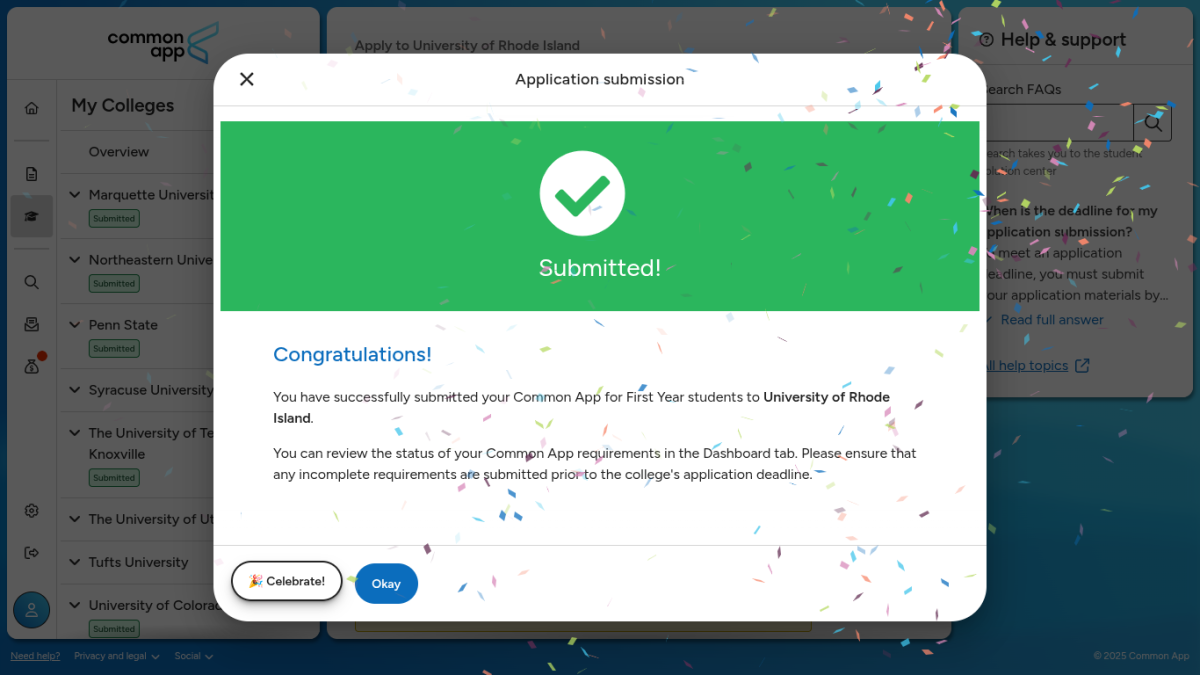
It’s Saturday, November 1, 2025, and the CommonApp celebrates with you as you submit your final application. Over the next few months, your email will see more of you than it ever has as you impatiently check for decisions.
However, as seniors, we began to wonder something: what even happens in the time period between submissions and decisions? What really goes on behind the scenes as the trajectory of our future is shaped?
There are three main styles of admission: regular admissions, selective admissions, and rolling admissions. In an interview with Shana Kinanne, the Senior Assistant Director of Recruitment at the University of Indiana Bloomington (IUB), we discussed both the general college admissions system and more specific questions to IUB.
The conversation suggested something: people often overcomplicate the process for themselves by failing to read the application closely. For Kinanne, students often submit their application to the wrong IU, such as submitting to IU Indianapolis (IUI) instead of IUB.
“In the common app right now, [IUB and IUI] both have the same logo…I think that now people just see the trident logo and they’re like, oh yeah, this is the right campus that I want to apply to, and it’s not,” Kinanne stated.
Overall, these minor mistakes appeared to be the most complex parts of the college admissions process. Otherwise, the different admissions styles make an easy-to-follow system.
The first and most common style is regular admissions which includes Early Action and Regular Decision; it occasionally has Early Decision as well. Early Action is a non-binding application where students have until May 1, the national reply deadline, to make their final choice; Early Decision is a binding application where a student commits to enrolling at a school if accepted; Regular Decision is the non-binding application timeline where students submit applications by a January or February deadline and are notified of their acceptance, rejection, or waitlist status in March or April. A popular example of a regular admissions college for Naperville North students is IUB which has deadlines for Early Action on November 1, 2025 and Regular Decision on February 1, 2026 for the Fall 2026 application.
Overall, the process for colleges like UIB is extremely common but still taken very seriously.
“Most times we’re spending ten to fifteen minutes on an application. We’re really making sure that the student is not only going to be a good fit at IU Bloomington, but that they’re going to be successful at IU Bloomington in the major that they have chosen for themselves as well,” Kinanne said.
She further explained how the applications are reviewed daily through a committee-style reading and discussion before each student is accepted or rejected. Later in the year, all the decisions are released on the same day, meaning that a student’s application could be decided months before the date of their decision release.
The second and more feared style is selective admissions, which is most commonly associated with Ivy League schools or “The Public Ivies,” which you can read more about here.
Oftentimes, more selective universities only offer Early Decision and Regular Decision deadlines. By removing the Early Action component, they are able to focus the first round on students who are prioritizing their institutions above all others. The universities tend to admit more students in the first round for this reason, and many Naperville North students take advantage of this. With that said, they do not admit a high percentage of those who apply. For example, the University of Pennsylvania (UPenn), an Ivy League University, has a 4.9% acceptance rate, meaning they only accepted 3,530 students out of 72,544 applicants for the Class of 2029. Due to the selectivity and prestige associated with the process, these applications are even more thoroughly reviewed by many officers before their application is decided on. The Daily Pennsylvanian reported how applications are reviewed in these cases.
“…Officers [are] split into teams of two and read one application at the same time in the office. Then they discuss the application together and come to a consensus before passing it along…. [then] it is given to admission officers responsible for the geographic region where the applicant lives. An exceptional applicant may skip this step and be handed immediately to a selection committee that includes school-based representatives. This committee will make the final decision on a potential acceptance,” The Daily Pennsylvanian said.
Additionally, prestigious universities such as these often focus on different things per round of reviewing. The first read is most likely going to look more at measurable parts of your application—GPA, standardized tests, level of involvement—and the second and third reads focus more on qualitative factors—how well the applicant “fits” in the incoming class, special circumstances, and talents.
The final application style is rolling admissions.
Rolling admissions is a rarer style of admissions that reviews applications and sends decisions as they are submitted. We interviewed Kirk Kluver, the Assistant Provost and Executive Director of Admissions at the University of Iowa, about rolling admissions specifically. We discussed how this type of admissions process creates many positives for the students as their applications are typically reviewed without comparison to the rest of the incoming class and they receive decisions at a much quicker rate.
“[Rolling admissions are] certainly student friendly…a student would know their admission decision pretty early in the process…I think that there’s a lot of universities that don’t have rolling admissions that would love to do it but they just can’t,” Kluver shared.
Kluver discussed how other universities struggle to create this advantage for students as they receive such a large volume of applications and are too selective that they simply cannot afford to adopt this process, and “they really do need to have kind of a holistic view of the applicant,” Kluver said.
Overall, the admissions process is disparate between every school, but all of them devote thoughtful consideration to each applicant. If you are not accepted to the university you desire, it is important to understand that the decision about your application was not made carelessly by any means. And, even if you are rejected, it may not be as catastrophic as it may feel in the moment.
“It all works out in the end…. The college years will be great years—wherever you go,” Kluver reassured.